How to Reduce Sales Ramp Time: Diagnose the Constraint First

On this page
Sales ramp is often presented as a simple sequence. A new hire completes onboarding, starts selling, and moves toward full productivity. That view can cause teams to treat every delay as an onboarding problem, even when something else is slowing the rep down.
The source of the delay matters because the same result can come from very different constraints. A rep may know the product but struggle to run discovery. A manager may see the gap but lack the time to coach it. Another rep may be ready for live conversations but remain held back by delayed CRM access, a weak territory, or too few relevant opportunities.
More onboarding content will not fix delayed access, a weak supply of opportunities, or a lack of coaching capacity. Before choosing an intervention, separate what the rep knows, how the rep performs, and the conditions in which the work takes place.
Reducing ramp time starts with a clear diagnosis. Define full productivity for the role, locate the earliest delay, remove it, and then confirm that reps reach the same productivity threshold sooner.
TL;DR
- Define the exact productivity threshold for the role before changing onboarding.
- Measure the path from start date to that threshold for comparable cohorts.
- Find the earliest delay: knowledge, conversation execution, manager capacity, process, territory, data, or opportunity volume.
- Test one change against the same leading indicator and productivity outcome.
Define ramp time for the role
Define the point at which the rep is fully ramped: what the rep must be able to do and which business result shows consistent performance.
This exit condition gives ramp time a fixed endpoint. Sales Benchmark Index's July 2007 discussion of ramp time defines full productivity as reaching 100% of the monthly sales goal. SBI's 2025 Modern Enablement Benchmarks Report, based on 134 US sales organizations surveyed in September 2024, tracks quota attainment, sales activity, certification pass rate, time to first sale, and time to productivity as separate measures.
For a given role and cohort, calculate ramp time as:
`Ramp time = date the agreed productivity threshold is first met - rep start date`
Use the same threshold and method every time. Otherwise, a faster first meeting can look like a shorter ramp even when full productivity did not arrive sooner.
The endpoint still needs to reflect the role. The examples below separate readiness, early progress, and full productivity. Use them as starting points instead of universal benchmarks, then set thresholds that reflect the sales cycle, segment, territory, and opportunity supply.
- Readiness could mean that a rep can open a call, show relevance, qualify the buyer, handle common objections, and agree on a clear next step.
- Early progress could then appear in one of these outcomes.
- Qualified meetings accepted by the receiving sales team
- Opportunities advancing after meeting agreed stage-exit criteria.
- Onboarding milestones and documented customer outcomes.
- Full productivity could then be defined by a documented activity-and-opportunity-quality threshold that accounts for segment, territory, and data quality.
An example definition of full productivity
For an account executive, a team might define full productivity as finishing role and product training, running CRM and prospecting workflows without help, sourcing pipeline, and moving deals through the sales cycle independently. Quota attainment may remain part of the measure, but territory, inherited pipeline, and start timing can distort it. This is an example operating definition, not a benchmark.
Build a baseline you can compare
Measure the current path from the rep's start date to the agreed outcome, including early indicators of progress and the final business result.
For each hire cohort, record:
- Role, segment, territory, and start date.
- The readiness and full-productivity definitions used for the cohort.
- Time to first qualified meeting, opportunity, or other role-specific leading indicator.
- Time to the agreed productivity threshold.
- Certification attempts and scorecard results.
- Manager coaching frequency and the evidence reviewed.
- Material changes to messaging, systems, territory, data, or opportunity supply.
- Caveats that make the cohort difficult to compare.
Once the baseline is visible, use it to identify delays the team can remove. These may include waits for access, feedback, relevant practice, or live opportunities. After removing a delay, check whether reps reach the agreed productivity threshold sooner. Earlier activity alone does not show that ramp time has improved.
Copyable sales ramp diagnosis worksheet
- Earliest delay: Review the cohort timeline, access dates, practice attempts, calls, and opportunity history. Name the first point where progress slows.
- Knowledge or conversation execution: Review answer accuracy, roleplay evidence, and live-call evidence. Decide whether to teach missing information or rehearse the weak call behavior.
- Manager capacity: Review the time from attempt to feedback, scoring variance, and action follow-through. Decide whether to simplify the review queue or assign an owner.
- Work environment: Review CRM access, process rework, territory quality, contact coverage, and opportunity supply. Fix the operating condition before adding training.
- Result: Reuse the same threshold and cohort method after the change. Keep, revise, or stop the intervention based on whether reps reach productivity sooner.
Remove the earliest delay
Start with the earliest point at which progress consistently breaks down. Treat the apparent cause as a hypothesis, and use call evidence, workflow data, and manager observations to decide what needs to change.
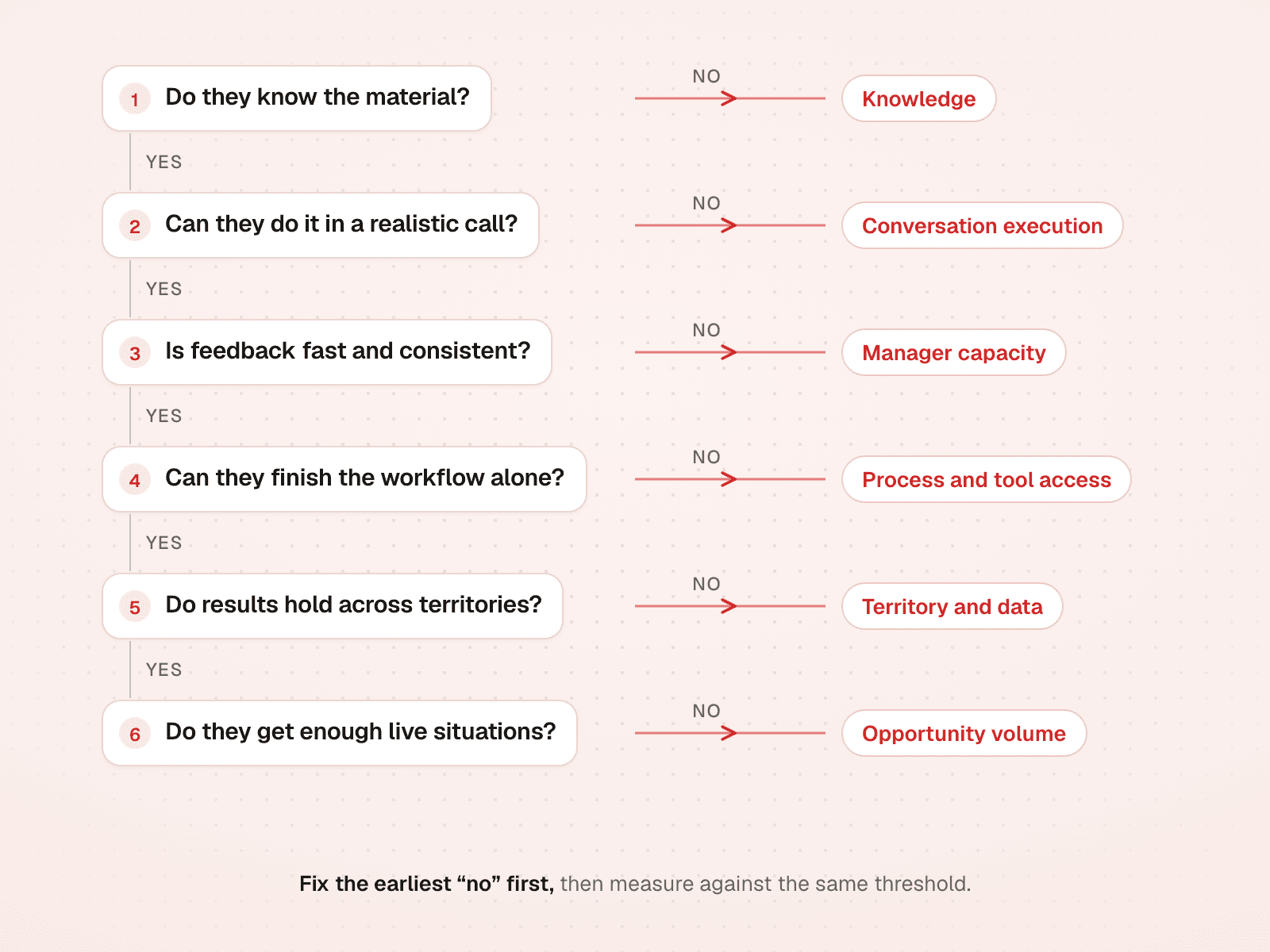
Suspected constraint | Evidence to review | First response to test |
|---|---|---|
Knowledge | Answer accuracy, knowledge checks, call transcripts, and repeated topic errors | Teach and rehearse the missing information |
Conversation execution | Roleplay and live-call scorecards, questions, objection responses, and next-step clarity | Practice the weak scenario with a rubric, feedback, and a targeted retry |
Confidence | Call avoidance, attempt volume, rushed moments, and performance after repetition | Test a narrow scenario repeatedly, then use controlled live exposure |
Manager capacity | Coaching frequency, scoring variance, feedback delay, and action follow-through | Simplify the review queue and focus one review on the highest-impact behavior |
Process and tool access | Permission delays, CRM errors, workflow rework, and asset search time | Remove the operating bottleneck before adding training |
Territory and data quality | Account fit, contact coverage, data accuracy, segment mix, and outcomes by comparable book | Correct the territory or data issue and use a matched comparison |
Opportunity volume | Relevant opportunities by call type, stage, segment, and rep | Increase relevant live exposure where possible and use practice between opportunities |
Knowledge
- If the rep gives inaccurate answers, misses important product or market context, or struggles to explain the company's positioning, knowledge may be the constraint.
- To confirm it, review knowledge checks, call transcripts, answer accuracy, and the specific topics that cause errors.
- When the evidence confirms a knowledge gap, focus learning and retrieval practice on the missing information. Then ask the rep to apply it in a conversation.
Conversation execution
- If reps can explain the framework in training but cannot apply it in a realistic call, conversation execution may be the constraint.
- To confirm it, review roleplay and live-call scorecards, talk tracks under buyer pressure, objection responses, question quality, and next-step clarity.
- When the evidence confirms an execution gap, use scenario-specific practice with an explicit rubric, graduated difficulty, feedback, and a targeted retry.
Confidence
- If reps avoid calls, rush through key moments, or abandon a reasonable approach after light buyer resistance, confidence may be affecting progress.
- To investigate it, review call avoidance patterns, attempt volume, differences between prepared and unprepared scenarios, and whether execution improves with repetition.
- Until the evidence rules out knowledge and skill gaps, continue to treat confidence as a hypothesis. Test it through repeated practice on a narrow scenario, followed by controlled exposure to live work.
Manager capacity
- If feedback is inconsistent, coaching takes days to arrive, or standards vary across managers, manager capacity may be slowing progress.
- To confirm it, review coaching frequency, scoring variance, the time from call to feedback, and whether assigned actions are revisited.
- When capacity is the constraint, test a shared scorecard, an evidence-based coaching queue, and one weekly review focused on the highest-impact behavior.
Process and tool access
- If reps know what to do but cannot complete the workflow without help, access or process may be the constraint.
- To confirm it, review CRM errors, permission delays, workflow rework, time spent locating assets, and handoff failures.
- When the evidence points to access or process, remove that bottleneck and remeasure the result before adding training.
Territory and data quality
- If activity is high and execution appears sound, but outcomes vary sharply by book or territory, then territory or data quality may be the constraint.
- To confirm it, review account fit, contact coverage, data accuracy, segment mix, and outcome differences across comparable reps.
- When the evidence points to territory or data, correct the issue and use a matched comparison. Coaching alone cannot create addressable demand.
Opportunity volume
- If reps pass certification but receive too few relevant live situations to build or show proficiency, opportunity volume may be the constraint.
- To confirm, review the opportunity count by call type, stage, segment, and rep. Then compare the time between repetitions with the exposure required for the role.
- When opportunity volume is the constraint, increase access to relevant work where possible and use practice to maintain repetition between live opportunities. Continue to keep simulated proficiency separate from revenue productivity.
Build role-specific 30/60/90-day milestones
Once the team understands the constraint, use a 30/60/90 plan to organize the rep's progress through three stages. The first 30 days focus on learning the product, sales process, tools, and role expectations. Over the next 30 days, apply that knowledge through supported work and practice. The final 30 days move the rep toward greater independence and the performance expected for the role.
Use the timeline as a shared structure instead of a fixed schedule. Move a rep forward as soon as the evidence shows readiness. If a gap remains, fix it without repeating steps the rep has already completed.
For each 30-day period, define:
- Name the call types the rep must handle at that stage.
- Decide whether a simulation, a recorded live call, a workflow output, or a business result will show readiness.
- Identify who will review the evidence and how the team will check scoring consistency.
- State the minimum standard, acceptable variance, and what happens when a rep does not pass.
- Define the coaching or live-work decision that follows the result.
Then make the milestones more realistic as the rep progresses. Early practice may isolate a single skill, while later practice should integrate buyer context, objections, stakeholder dynamics, and a complete next step.
Move practice before customer risk
Milestones also need to show what reps can do. Shadowing and content review may show them what good looks like, but those activities alone do not show whether they can execute when a buyer interrupts, challenges, or reveals unexpected context.
Use scenarios that reflect the calls the rep will actually take. Begin with one objective, add complexity gradually, and score observable behavior instead of confidence or polish alone. For the opening moments, the cold-calling roleplay guide provides graduated scenarios and observable pass criteria.
Keep the readiness loop short so practice does not become another delay.
- Begin with one realistic scenario and share the buyer context, success criteria, and scoring rubric before the attempt.
- Use that rubric to score the attempt once. If the rep meets the standard, move them into the next level of live work.
- If the score falls short, coach the most important gap and retry only the relevant skill or scenario.
What a readiness checkpoint can look like
A readiness checkpoint can use a real opportunity without exposing the buyer. The rep reviews a sanitized CRM record, researches public account context, rehearses the buyer conversation, and receives a score against a rubric shared in advance. This tests how the rep responds to an interruption or objection, which a recorded pitch cannot show.
Use certification to prevent repeat work
Set the standard before the attempt so the decision can be made quickly. Name the conversation, evidence, rubric, scorer, and pass threshold. A prepared rep who meets the standard should advance on the first attempt. When a rep falls short, coach the specific gap and use a targeted retry.
In practice, use a single standard, recognize what the rep has already shown, and repeat only the parts that need improvement. Certification shows readiness for the next stage, not full productivity.
Shorten the wait for useful feedback
Once an attempt has been scored, managers need a clear next action. Give them a short, ranked view of the behavior that is blocking progress and the evidence supporting it. More raw data can obscure the issue and make the next coaching action harder to identify.
Readiness analytics can support that focus by identifying which behaviors need coaching. This allows managers to avoid listening to every attempt from start to finish while still reviewing enough evidence to understand the context and maintain scoring quality.
Carry that context into live work by using current call evidence to correct one issue at a time.
Let those live issues shape the next practice assignment. If the call evidence shows weak objection handling, assign a scenario with that objection. If a new product changes discovery-call practice, update the rubric and reassess only the relevant part of the conversation.
Keep each correction narrow and timely. Fix the exact gap, confirm that it has improved, and move the rep forward.
Where manager time becomes a constraint
When managers spend too much time reviewing full calls and compiling recurring gaps, the delay sits between the evidence and the next coaching decision. AI should not replace manager judgment here. A useful workflow shortens that delay while leaving the manager in control of the standard.
Confirm that reps reach productivity sooner
Once the intervention is in place, compare cohorts using the same role and productivity definition. Control or document material differences in segment, territory, manager, lead source, sales cycle, and opportunity availability.
Use that comparison to trace the full path from practice to live behavior and then to business outcomes.
- Did reps reach the readiness standard sooner?
- Did the targeted behavior improve in live calls?
- Did opportunity quality or stage progression improve?
- Did reps reach the agreed productivity threshold sooner?
- Did the change hold after onboarding?
To check whether practice carries into customer conversations, compare practice with live calls.
Apply the same evidence standard to percentage reductions, average ramp duration, ROI, and customer results. Report those claims only when you can state the source, sample, role, period, and method.
Frequently asked questions
How do you calculate sales ramp time?
Choose one full-productivity threshold for the role. Ramp time is the interval between the rep's start date and the first date they meet that threshold. Keep readiness, first activity, first sale, and full productivity separate so cohorts remain comparable.
What is the fastest way to reduce sales ramp time?
Find the earliest delay and test the matching fix. More training will not fix missing system access, poor territory data, limited opportunity supply, or delayed manager feedback.
Can AI roleplay reduce sales ramp time?
AI roleplay may help when conversation execution, practice access, or scoring consistency is the constraint. Its workflow benefits do not prove a shorter ramp. Compare the same readiness indicator and productivity threshold before and after the change.
What belongs in a 30/60/90-day sales ramp plan?
For each period, name the call types, required evidence, reviewer, passing standard, acceptable variance, and the decision that follows. Move a rep forward when the evidence shows readiness, even if the calendar says the stage should last longer.
Which tools reduce sales ramp time without adding manager work?
Match the tool to the earliest delay. Use a knowledge system when reps cannot find accurate information, call review when managers need faster access to live evidence, roleplay when reps need more conversation repetitions, cohort analytics when the baseline is unclear, and workflow administration when access or process is the bottleneck. The tool should shorten the wait for evidence or feedback while leaving the manager in control of the standard.
Use AI roleplay when conversation practice is the constraint
Use it when the constraint is conversation execution, limited practice, or inconsistent evaluation. It can provide repeatable access to buyer contexts, targeted retries, and a consistent rubric across attempts, but those workflow benefits alone do not prove that sales ramp time improved.
AI roleplay cannot repair weak positioning, create manager accountability, grant system access, improve a poor territory, or supply a missing pipeline. It should also not be the only evidence used to determine whether a rep is fully productive.
When the fit is right, start with one role and one cohort. Give one person ownership of the fix, test one change, and compare the same leading indicator and productivity outcome before and after.
If conversation execution is the constraint, run a buyer-specific simulation in Quotain to test the specific call, score the evidence, and target the retry. If execution is not the constraint, direct the intervention toward the process, management, territory, data, or opportunity problem instead.