Sales Scorecard Templates: Sales Rep Scorecard and Sales Call Scorecard

On this page
A sales scorecard comes in two kinds. A sales call scorecard rates what a rep did in one conversation. A sales rep scorecard tracks one rep or team over a week, month, or quarter through results, activity, and call quality. Both should end with the same answer: what the rep should practice next. If a row says "confidence," "professionalism," or "communication," the rep may get a number without learning how to improve it.
The call scorecard template below uses behaviors a reviewer can cite in a recording or transcript. It also separates universal call habits from call-type criteria, so a follow-up call is not penalized for skipping work that belongs in discovery. Further down, the sales rep scorecard template reads results, activity, and call evidence together, with versions for SDRs, AEs, and account managers and a CSV you can open in Google Sheets or Excel.
TL;DR
- Keep a small universal core, then add a short module for the call type.
- Write criteria as actions a reviewer can see or hear.
- Use pass/fail for required actions and a 1/3/5 scale for skills with meaningful levels.
- Require evidence for every score. A timestamp, transcript line, or buyer response is more useful than a comment such as "good energy."
- Calibrate reviewers on the same sample calls before using results for coaching, certification, or team reporting.
- Turn the lowest useful criterion into one short practice drill and an immediate retry.
- Use a separate rep scorecard for 1:1s and team reviews. Put outcome, activity, and call-quality rows side by side, and do not blend them into one number.
What a good sales call scorecard measures
A good scorecard measures behavior inside a defined call type. It does not try to rate the rep's whole job from one conversation.
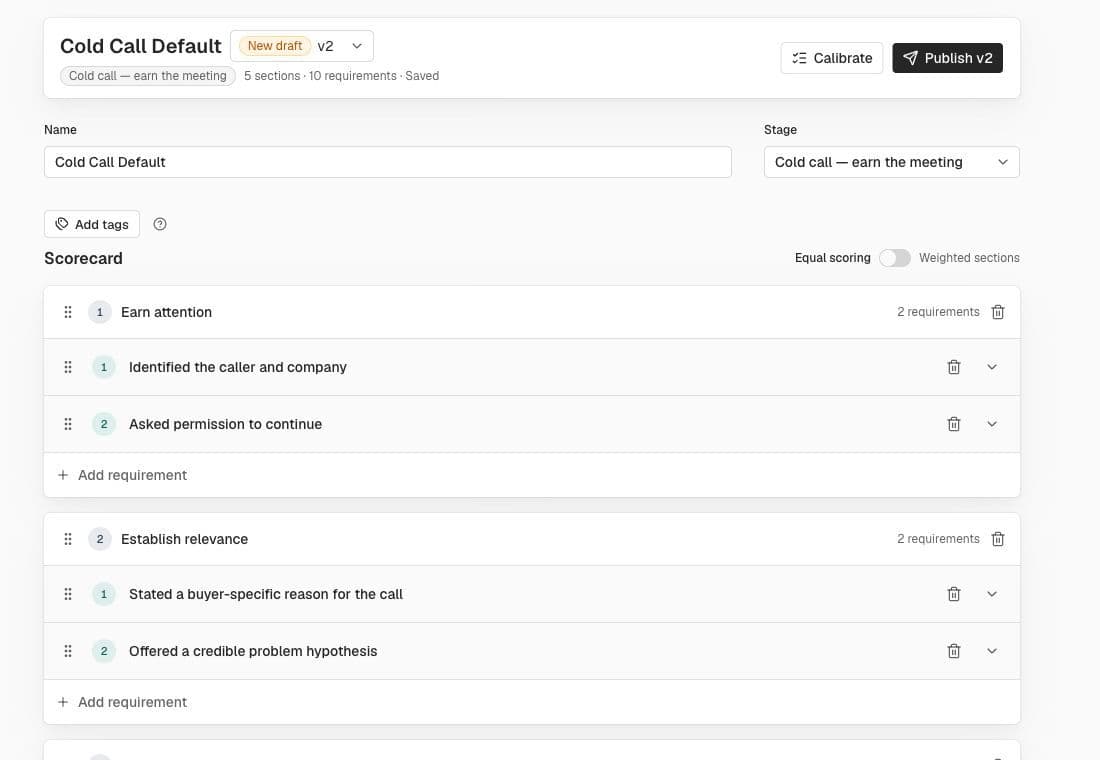
Use four layers:
- A universal core for actions that belong in nearly every consultative sales call.
- A call-type module for discovery, demo, pricing, follow-up, or another stage.
- Evidence fields that show why the reviewer gave the score.
- A coaching action tied to the criterion that needs work.
Keep activity metrics such as calls made or emails sent, and deal outcomes such as stage conversion, off the call scorecard. They describe the rep's week or pipeline, not the conversation. When a manager needs one view of a rep, use the rep scorecard later in this guide, which places those measures next to call-quality evidence.
Do not force one scorecard across every call
When we reviewed call grading with one sales team, they found that a single rubric produced too many N/A rows. A warm follow-up may contain no new discovery. A discovery call may have no price negotiation. Treating missing stages as failures creates noise.
Start with a common core, then attach the module that fits the call.
Call type | Keep in the universal core | Add for this call | Usually leave out |
|---|---|---|---|
Cold call | Relevance, listening, next step | Opening, permission, early objection response | Deep solution mapping |
Discovery | Agenda, listening, next step | Problem depth, effect, urgency, decision path | Detailed negotiation |
Demo | Listening, relevance, next step | Use-case fit, proof, question handling | Full first-call qualification |
Pricing or negotiation | Listening, relevance, next step | Value link, objection diagnosis, trade discipline | Broad agenda discovery |
Follow-up | Context recall, listening, next step | Progress since last call, blocker, decision path | Repeating settled discovery |
This structure also makes coaching cleaner. A rep can be strong at discovery and still need a separate pricing drill. One total score would hide that distinction.
Choose the scoring scale for the decision
The teams we worked with landed on different scales because they were making different decisions.
- An enablement practitioner found binary scoring too reductive for conversation skills with several quality levels and preferred an even-numbered scale with a written behavior at every level.
- Another team found that a large generic rubric created too many N/A rows. They favored call-type scorecards and simpler scales where the behavior allowed it.
- One customer told us inaccurate feedback was the main reason to distrust a scorecard. The useful fix was calibration on past calls, not a more precise-looking number.
Use pass or fail when the action is genuinely binary, such as stating a required disclosure. Use a small anchored scale when quality has meaningful levels, such as discovery depth. Use an even-numbered scale when a readiness decision requires the reviewer to choose which side of the standard the performance falls on.
Whichever scale you choose, define every available value and test it on several calls. A five-point scale with only 1, 3, and 5 defined is an unfinished rubric. A four-point scale with overlapping descriptions has the same problem.
Copyable sales call scorecard
Download the editable Word template or Markdown template. The download uses only scores 1, 3 and 5, with N/A reasons, evidence notes and a next-practice plan.
Use the 1, 3, and 5 anchors below. If you keep a five-point system, define scores 2 and 4 in your own rubric before use.
Criterion | 1: Missed | 3: Partial | 5: Strong | Evidence |
|---|---|---|---|---|
Purpose and agenda | Starts without a clear purpose or buyer input | States a purpose but does not confirm the buyer's goal | Agrees on purpose, buyer need, and intended outcome | Timestamp and buyer confirmation |
Listening and follow-up | Moves to the next prepared point after the buyer answers | Refers to the answer but follows it only once | Changes the line of questioning based on buyer detail | Question and buyer response |
Problem depth | Accepts a surface problem | Learns one effect or cause | Learns the problem, effect, and why it matters now | Buyer language and consequence |
Value relevance | Gives generic product benefits | Connects one benefit to the topic | Connects an approved capability to buyer-stated evidence and checks the fit | Buyer quote and rep link |
Objection diagnosis | Defends or rebuts immediately | Asks one clarifying question | Clarifies the concern, identifies its type, and responds with relevant evidence | Objection, question, evidence used |
Commercial judgment | Gives ground without a clear trade or boundary | Holds the first request but lacks a plan | Trades within approved limits and receives a commitment for each move | Request, trade, buyer commitment |
Mutual next step | Ends with a vague follow-up | Names an action but misses owner or timing | Confirms action, owner, timing, and buyer agreement | Final exchange |
Call control | Follows the original plan after the call changes | Notices the change but adapts late | Resets the plan with the buyer when time, goal, or participants change | Reset language and buyer response |
For a required action such as a compliance statement or a confirmed next-step date, pass/fail may work better. Binary criteria reduce interpretation: the action happened or it did not. Keep a comment field for context.
Write criteria that produce evidence
The test for a scorecard row is whether a reviewer can underline the proof.
Weak criterion: "Built rapport."
Stronger criterion: "Referred to a buyer detail and checked whether the interpretation was accurate."
Weak criterion: "Handled objections well."
Stronger criterion: "Asked at least one question about the concern before making a product claim."
Weak criterion: "Closed effectively."
Stronger criterion: "Confirmed an action, owner, and date that the buyer accepted."
The buyer response matters too. A rep may ask an impact question, yet the buyer gives no effect because the wording was unclear or the timing was wrong. Store the rep action and the buyer evidence together.
Handle repeated behaviors without hiding the misses
One call may contain several objections or several attempts to set a next step. A single yes/no row can hide the pattern.
Use an instance log:
Moment | Criterion | Result | Evidence | Coaching note |
|---|---|---|---|---|
12:10 | Objection diagnosis | Pass | Rep asks what changed in the budget process | Keep the same opening question |
21:42 | Objection diagnosis | Miss | Rep answers an integration concern from memory | State the limit and confirm the technical owner |
28:55 | Mutual next step | Partial | Action named, date left open | Retry the final two minutes |
The summary score can then reflect the pattern without erasing the second miss. For coaching, the moment and note are usually more useful than the average.
Calibrate managers before the scorecard matters
Calibration checks whether different reviewers apply the same written standard to the same call.
Choose sample calls
Pick several calls for each call type. Include a clear pass, a clear miss, and a borderline example. Remove private account details when the review group does not need them.
Score independently
Each reviewer completes the scorecard without seeing anyone else's ratings. Require evidence for every criterion.
Compare the evidence before the numbers
When scores differ, ask which transcript moment each reviewer used and how the written anchor applies. Do not average away a disagreement. Fix the criterion or choose the rating supported by the call.
Rewrite unclear rows
If reviewers keep disagreeing, the row is probably too broad, the score anchors overlap, or the call type is wrong. Split the behavior, define the missing level, or move the row into a call-type module.
Recheck after changes
Score a fresh sample after the rubric changes. Add a short calibration whenever a new manager joins or a team changes its sales process.
If AI suggests scores, use the same benchmark calls and written criteria. Quotain's real-call grading links each criterion to exact conversation evidence. Human reviewers still need to check the rubric, the evidence, and whether the result is fit for the decision being made.
Turn a score into a practice plan
- Pick one criterion with a meaningful miss.
- Open the exact call moment behind it.
- Write the behavior the rep needed.
- Recreate the buyer pressure around that moment.
- Let the rep retry the exchange.
- Score the same criterion on the retry.
- Check the behavior again on a later live call.
If a rep misses discovery depth, do not assign a generic communication course. Give them a buyer who states a surface problem and score whether they uncover its effect. If they miss next-step discipline, replay the final two minutes with a buyer who sounds interested but avoids a date.
Use the broader sales skills practice guide when a category needs a clearer behavior and drill. For an objection-specific miss, the objection-handling roleplay scenarios provide buyer context, hidden concerns, and pass evidence that can reuse the same scorecard criterion.
Quotain's AI sales simulations can isolate pricing, discovery, technical questions, or next-step practice. The score and retry should use the same behavioral standard as the real call. In Quotain learning modules, criteria marked critical must be met for a task to pass, which matches the pass/fail treatment of required actions.
Sales rep and team scorecard template
A call scorecard rates one conversation. A sales rep scorecard, sometimes called a salesperson or sales team scorecard, summarizes a rep's period: the result the role is measured on, the activity behind it, and the call behaviors most likely to explain a gap. Keep them as two documents. The rep scorecard reads from the call scorecard. It does not replace it.
Question | Call scorecard | Rep or team scorecard |
|---|---|---|
What it reviews | One call of a known type | One rep, pod, or team over a week, month, or quarter |
Question it answers | What did the rep do in this conversation? | Where are results falling short, and which behavior is most likely behind it? |
Inputs | Recording or transcript, criteria, evidence | CRM results, activity counts, call-scorecard trends |
Typical rhythm | After selected live calls or practice sessions | Weekly 1:1 or monthly pipeline review |
Manager action | One drill and a retry | Pick the stage and the behavior to coach next |
Use the call scorecard to coach a specific conversation, certify readiness for a call type, or calibrate reviewers. Use the rep scorecard when a manager has to decide where coaching time goes across a pipeline, or when a leader reviews a pod.
What teams told us about rep-level measurement
- Managers and enablement read the same rep differently. An enablement specialist we interviewed said sales managers mostly watch closed deals and quota, while enablement watches the process that produces them.
- An enablement leader told us they measure programs as pairs of leading and lagging indicators: a target behavior and the result it should move. The same leader said proving that the behavior caused the result is still hard, even with call and CRM data.
- The result row depends on the role. One enablement program manager told us SDR quota meant qualified meetings the AE accepted, while AE quota meant signed deals. For AEs, they judged ramp by whether the rep was sourcing pipeline and moving deals forward without help, because territory and inherited pipeline make early quota numbers hard to read.
- A fractional CRO we spoke with starts a sales diagnostic with funnel data (stage conversions, win rates, deal sizes, and cycle length) and then reviews recorded calls and deal files.
- Teams disagree on how much weight call quality deserves. An advisor with revenue operations experience argued that outcomes, such as whether the deal moved forward, matter more than call-quality ratings. The same advisor warned that reps tune out when a scorecard shows too many numbers and words.
- A newer rep at one customer had logged dozens of cold calls and a steady run of conversations, with no meetings booked yet.
Copy the sales rep scorecard template
Our recommendation: keep outcome, activity, and call quality as separate rows, read them in that order, and end with one coaching action. Do not blend them into one weighted score. A strong call-quality trend cannot make up for a missing result, and a high activity count says nothing about the conversation. In the cold-call example above, the counts showed effort and a result gap, but they could not show which part of the call to practice. That answer sits in the call evidence.
Area | Measure | Where it comes from | How to read it |
|---|---|---|---|
Outcome | The result the role is measured on, such as AE-accepted meetings for an SDR or closed-won deals for an AE | CRM | Is the rep producing the result this period? |
Outcome | Conversion at the one stage you are coaching this period | CRM | Where do this rep's conversations or deals stall? |
Activity | Conversations held, counted apart from dials or emails sent | Dialer, CRM, or calendar | Is there enough volume to judge the result? |
Activity | Assigned practice completed on the target criterion | Practice records | Did the coaching plan happen? |
Call quality | Trend on one or two call-scorecard criteria tied to that stage, with the number of calls reviewed | Calibrated call scorecards | Which behavior most likely explains the gap? |
Call quality | The same criterion in practice and on the next live call | Practice and call reviews | Is the drill carrying over to real buyers? |
Next action | One behavior, one drill, one recheck date | Manager | What changes before the next review? |
Download the CSV template to open it in Google Sheets or Excel. It adds empty columns for this period, the target, and a status (on track, watch, or off track), plus the role rows below. Set each target from your team's own history. We do not publish benchmark targets, because the right number depends on role, segment, sales motion, and call type.
Read the rows from top to bottom. Start with the outcome gap, find the stage, then open the call evidence for that stage. If conversations are steady but meetings are not booking, review the opening and next-step criteria on recent calls before asking for more dials. If early stages convert but deals stall later, move the call-quality rows to the stage where they stall.
Adjust the rows for each role
Keep the same structure for every role. Change the outcome row, the stage you coach, and the call criteria you trend. The outcome rows are lagging indicators: they report the result once the period is over. The activity and call-quality rows are leading indicators, which a manager can still change during the period.
Role | Outcome row | Stage to coach | Activity row | Call criteria to trend |
|---|---|---|---|---|
SDR or BDR | Meetings the AE accepted | Conversation to booked meeting | Conversations held, counted apart from dials | Opening and permission, objection diagnosis, mutual next step |
Account executive | Closed-won deals | The stage where this rep's deals stall | Discovery calls and demos held | Problem depth, value relevance, mutual next step |
Account manager or CSM | Renewals and expansion, as your team defines them | Renewal or expansion conversation | Account reviews held | Listening and follow-up, commercial judgment, mutual next step |
Other outcome measures often appear on rep scorecards: win rate, average deal size, sales cycle length, and pipeline coverage for AEs; pipeline sourced and meetings held for SDRs; renewal rate and expansion pipeline for account managers. Pick one for the outcome row and leave the rest on the dashboard. A longer list makes the scorecard harder to read in a 1:1 without making it more accurate.
Review a rep's scorecard in the weekly 1:1 and the team view once a month. Change the rows only at the start of a quarter or when the sales process changes. If the rows change every few weeks, the trend lines stop meaning anything.
For a team or pod scorecard, use the same rows for every rep. Compare the same criteria on comparable call types, and check how many calls sit behind each score before treating a difference as a skill gap. Keep the full evidence underneath, and show the rep the outcome plus one or two priorities first. The 30-minute coaching 1:1 is a good place to review it.
Quotain's readiness analytics connects criterion scores with the calls and practice attempts behind them, which covers the call-quality rows. Outcome and activity rows still come from your own CRM and reporting.
How to use scorecards fairly
- Share the rubric before the call or practice session when it is used for readiness or certification.
- Keep criteria tied to the rep's role and the call's purpose.
- Do not treat transcript-only scoring as proof of tone, facial expression, or buyer sentiment.
- Keep coaching scores separate from disciplinary or compensation decisions unless the company has tested the rubric for that use and completed the needed review.
- Let reps see the evidence and respond to it.
- Track criterion trends across similar calls. Do not compare unlike call types through one total score.
FAQ
What is a sales call scorecard?
A sales call scorecard is a rubric for reviewing observable behaviors in a sales conversation. It connects each rating to call evidence and a coaching action.
What is the difference between a sales scorecard and a call scorecard?
A call scorecard rates the behaviors in one conversation. A sales scorecard, or sales rep scorecard, tracks one rep or team over a period through results, activity, and call-quality trends. Use the call scorecard to coach a conversation and the rep scorecard to decide where coaching time goes.
What should a sales rep scorecard template include?
Include the result the role is measured on, conversion at the stage you are coaching, conversations held, assigned practice completed, a trend on one or two call-scorecard criteria, and one next action. Set targets from your team's own history.
Is a sales scorecard the same as a sales dashboard?
No. A dashboard shows live team and pipeline numbers that anyone can filter. A sales scorecard is a short, fixed set of rows for one rep or team. You read it against targets on a set schedule, and it should end with a coaching action. Both can pull from the same CRM data.
Should a sales rep scorecard use weighted scores?
Some published templates weight each metric and add them into one composite score. For coaching, we recommend separate rows instead. A single number hides which row moved, and a high activity count can cover a missing result. If leadership needs a composite to rank reps, keep it on the dashboard and keep the rep scorecard as separate rows that end in one coaching action.
How often should you review a sales rep scorecard?
Review each rep's scorecard in the weekly 1:1 and the team or pod view once a month. Change the rows only at the start of a quarter or when the sales process changes, so the trend lines stay comparable.
What should a sales call scorecard include?
Use a small universal core, a call-type module, clear scoring anchors, an evidence field, and a next-practice field. Put activity and deal-outcome metrics on a rep scorecard.
Should a scorecard use pass/fail or a 1-to-5 scale?
Use pass/fail for required actions with a clear yes-or-no result. Use a scale when the skill has real levels, but define every level. A 1/3/5 anchor set can serve as the starting point for a fully defined five-point rubric.
How many criteria should a call scorecard have?
Use the fewest criteria needed to coach the call's purpose. One enablement leader we interviewed preferred four to six scored behaviors, each with a short reason, plus a summary of the top coaching priorities. If managers skip rows or use N/A often, split the rubric by call type or remove low-value criteria.
How do managers calibrate sales-call scoring?
Have reviewers score the same sample calls independently, cite evidence for each rating, discuss gaps against the written anchors, rewrite unclear rows, and test the revised rubric on a fresh sample.
Can AI score sales calls?
AI can suggest criterion-level ratings and retrieve supporting transcript moments. A team still needs a clear rubric, benchmark calls, human calibration, and review suited to how the scores will be used.
Score the moment, then practice it
Start with one real call and one behavior that needs work. Try a Quotain simulation to replay the buyer pressure and give the rep a focused second attempt.