How Does AI Sales Roleplay Work? A Practical Walkthrough

On this page
AI sales roleplay gives a seller a buyer conversation to rehearse, then returns a transcript, a score, and a focused retry. The quality of that loop depends on the setup. A generic persona and a broad score produce generic feedback. A useful session starts with a real call stage, accurate buyer context, clear disclosure rules, and a rubric tied to observable behavior.
The software should give reps more chances to practice while managers keep control of the standard. It should not make promotion, certification, or performance decisions by itself.
TL;DR
- Start with one call moment, such as a cold-call opener, a discovery follow-up, or a pricing objection.
- Give the AI buyer public facts, private facts, and rules for when to reveal each fact.
- Tell the rep what they could reasonably know before the call and what outcome they should earn.
- Score observable behavior against a shared rubric and cite the transcript moment behind each score.
- Turn the weakest moment into a short retry, then compare the second attempt with the first.
What is AI sales roleplay?
AI sales roleplay is voice or text practice with a simulated buyer. The rep enters a defined sales situation, responds to the buyer in real time, and receives feedback after the conversation. A manager or enablement lead sets the scenario and the behaviors that count as a good attempt.
The AI plays the buyer and reviews the conversation. The human team decides whether the buyer setup is credible, whether the rubric matches the sales process, and what should happen after the score.
How AI sales roleplay works step by step
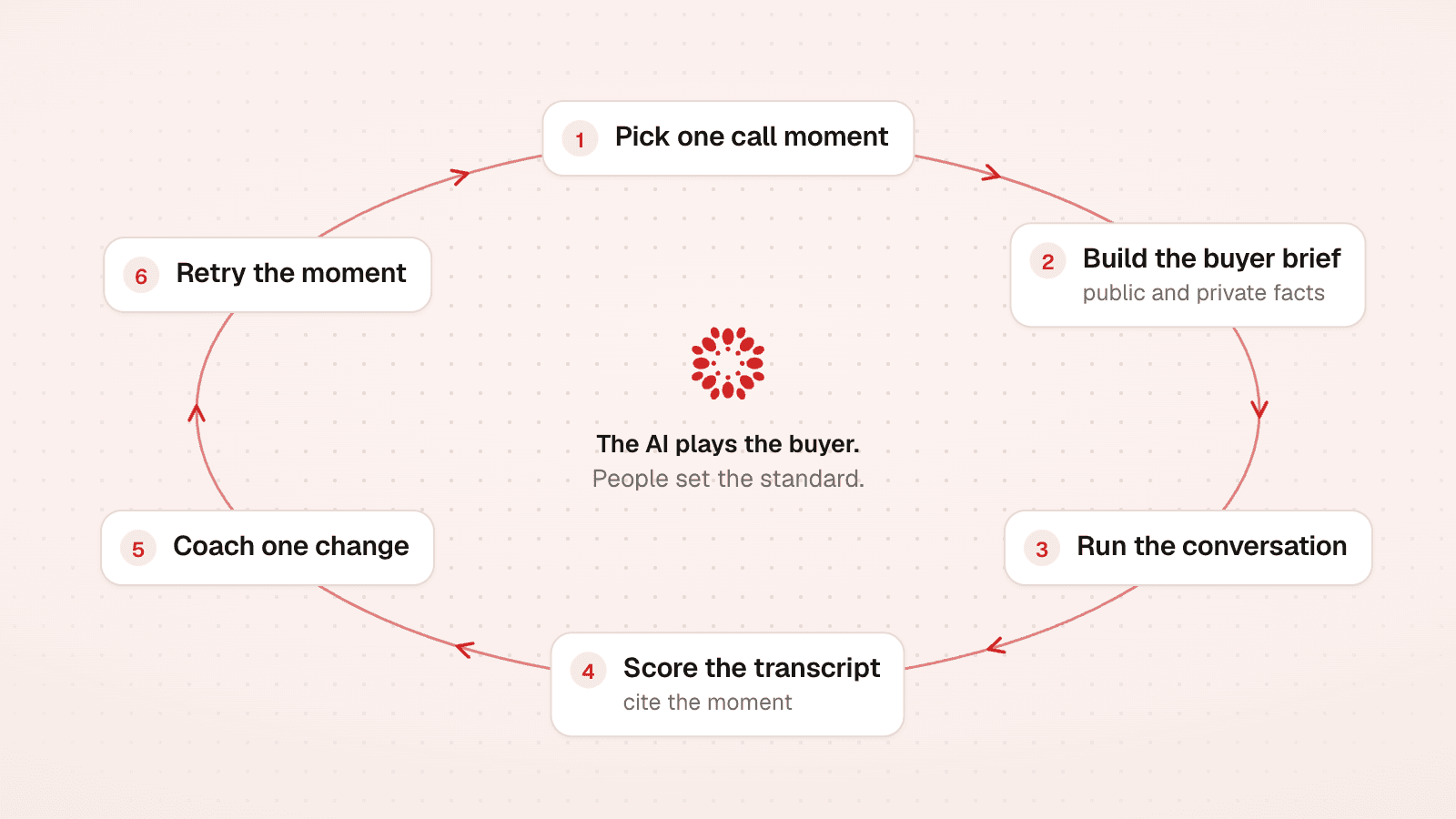
Stage | Input | What the AI does | Human check | Output |
|---|---|---|---|---|
1. Pick the call moment | Call stage, buyer, rep goal | Builds a bounded conversation | Is this a real task the rep faces? | Practice objective |
2. Set buyer rules | Known facts, hidden facts, pressure, reveal rules | Plays the buyer within those rules | Are the facts accurate and safe to use? | Buyer brief |
3. Run the conversation | Rep speech or text | Responds to the rep turn by turn | Does the buyer behavior feel credible? | Audio and transcript |
4. Score the attempt | Transcript and rubric | Finds evidence for each criterion | Does the evidence support the score? | Scorecard |
5. Choose one correction | Lowest or highest-risk miss | Suggests a next action | Is that action useful for the live call? | Coaching note |
6. Retry | Same moment with one change | Runs the pressure point again | Did the target behavior improve? | Before-and-after evidence |
1. Pick one call moment
Choose a moment with a clear seller decision. Examples include earning permission to continue a cold call, following up on a vague pain statement, responding to an early pricing request, or agreeing on a next step with an uncertain buyer.
A full mock call can be useful near certification. Early practice usually works better when the rep can repeat a narrower moment. If the rep is working on follow-up questions, there is little value in spending ten minutes on rapport and introductions before reaching the skill that needs work.
Write the objective as an observable result: "Uncover the workflow impact before discussing the product." Avoid goals such as "show confidence" unless the team can name the speech or behavior that counts as evidence.
2. Build the buyer brief
The buyer brief governs what the AI buyer knows and how it should respond. It should contain:
- Buyer role and company context
- What the rep already knows
- Private buyer facts
- The first buyer line
- Pressure tied to time, trust, proof, authority, or competing work
- Rules for when the buyer will reveal each private fact
- Likely responses to pitching, shallow questions, and useful follow-up
- A clear ending condition
Keep the rep brief separate. If the rep sees the buyer's private problem, decision process, and personal stake before asking, the session cannot test discovery skill. The discovery call roleplay guide includes complete rep and buyer briefs that show the split.
3. Run the live conversation
The AI buyer receives the scenario instructions, listens or reads, and generates the next buyer turn. It can disclose a private fact when the rep earns it, resist when the rep pushes too soon, and change its posture as the conversation develops.
Realism is partly a configuration problem. A buyer that knows too little will sound vague. A buyer that gives every fact away will make the exercise too easy. A buyer set to resist everything turns the session into argument practice. Test the opening, one good branch, and one poor branch before assigning the scenario to a team.
Voice matters when the live work happens by phone or video. Speaking forces the rep to manage pace, interruption, silence, and recovery. Text can still help with wording or short drills, but it removes part of the performance pressure.
4. Score transcript evidence
After the conversation, the system compares the transcript with the rubric. A sound rubric names behaviors that another reviewer can find in the call. Examples include:
- The rep confirmed why the problem matters now.
- The rep used the buyer's language when summarizing the issue.
- The rep tested the consequence of doing nothing.
- The rep agreed on an action, owner, and reason for the next step.
Avoid a scorecard with twenty broad traits. Score one or two skills during a focused drill. A full-call certification may need more criteria, but each one still needs a clear anchor. The sales call scorecard template shows how to pair each criterion with evidence and a coaching action.
The score should link back to the transcript. That lets the rep and manager inspect the same moment. If the score seems wrong, they can correct the rubric, the scenario, or the judgment instead of treating the number as final.
5. Turn the score into a coaching action
A useful report answers three questions:
- What did the rep do?
- What did the shared standard require?
- What should the rep try on the next attempt?
The answer should be narrow. "Ask better questions" gives the rep no clear move. "After the buyer names a missed deadline, ask who feels the impact and what changes if the deadline slips again" gives the rep a moment and a behavior to rehearse.
Managers still decide whether the correction fits the account, product, and sales process. They also decide when the rep is ready for a harder scenario, a live call, or certification.
6. Retry the weak moment
The retry is where feedback becomes practice. Run the same pressure point again, with the same pass condition, and ask the rep to change one behavior. Compare the transcript evidence from both attempts.
If the rep improves, raise the difficulty or move to the next call moment. If the same miss repeats, check whether the problem is missing knowledge, an unclear rubric, an unrealistic buyer, or conversation execution. Repeating a broken exercise will not fix the setup.
What AI can do well and where people stay in control
AI sales roleplay is well suited to repeated buyer turns, private rehearsal, transcript capture, first-pass scoring, and short retries. Those jobs can give a rep more attempts without asking a manager to sit through every round.
People should keep control of the parts that require company judgment:
- Which call deserves practice
- Which account facts may be used
- What good behavior looks like
- Whether the buyer portrayal is fair
- Whether the evidence supports the score
- What coaching or readiness decision follows
One useful design rule is to separate AI processing from human review. Sakuraseisai uses that split across setup, repeated practice, recording, reflection, and the next action. It is a better model than asking one score to act as coach, judge, and performance record at the same time.
How to judge an AI sales roleplay session
Test the workflow with one real call type before rolling it out. Use the same scenario with several reps and ask:
- Did the AI buyer follow the private facts and reveal rules?
- Did the buyer react differently to a shallow answer and a useful follow-up?
- Could a manager trace every score to the transcript?
- Did the coaching note point to one retry?
- Did the rep improve the target behavior on the second attempt?
- Did the exercise stay inside approved product and account facts?
If the team cannot answer those questions, more scenarios will add volume without better evidence.
When you are ready to test software, use the AI sales roleplay platform comparison to build a shortlist for the same scenario and scorecard.
Frequently asked questions
Does AI sales roleplay replace manager coaching?
No. It can handle repeated practice, transcript capture, and a first scoring pass. Managers still set the standard, check the evidence, coach judgment, and decide when a rep is ready for live work.
What information does an AI buyer need?
Give it the buyer role, account context, call stage, known and private facts, pressure, reveal rules, likely branches, and an ending condition. Give the rep only what they could know before the call.
How accurate are AI roleplay scores?
Accuracy depends on the rubric, transcript quality, scenario setup, and review process. Treat the score as reviewable evidence. Audit several attempts against a human scorer before using it for certification.
Should reps practice full calls or short drills?
Use short drills to correct one behavior and full calls to test how several skills work together. A rep who misses one pricing follow-up should retry that moment without repeating an entire discovery call.
How does live-call data fit into the loop?
Use approved call evidence to find the next practice moment. After the retry, compare the target behavior with later live calls. Real-call grading can connect the practice rubric with customer-call evidence while managers retain the final judgment.
Run the loop on one upcoming call
Choose one buyer moment that matters this week. Write the known facts, private facts, pressure, reveal rules, and one pass condition. Then run a buyer-context simulation in Quotain, inspect the transcript evidence, and retry the weakest moment before the live call.